The culture of experimentation
In a world where companies have the tools to ship features faster than ever, spending months researching and building something that nobody wants is increasingly indefensible.
Instead, we should promote an “experimentation-first” culture, where we test hypotheses and assumptions as quickly and cheaply as possible with real customers, then use the evidence to decide which ideas have earned further investment.
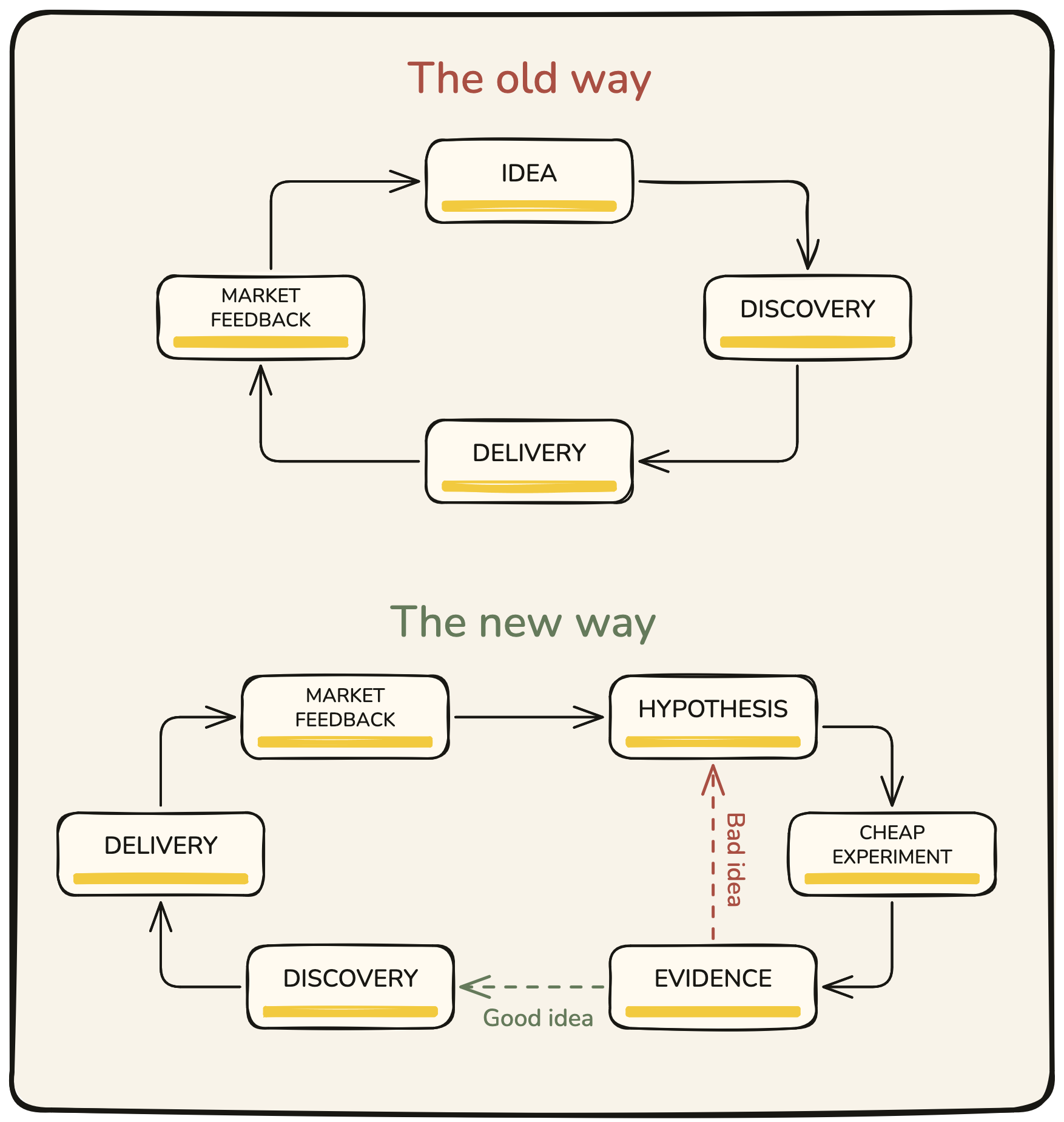
I want to be 100% clear on this: experimentation is not a replacement for proper discovery and delivery - it is the filter that tells us where those expensive efforts belong.
Why this matters
The barrier to building, testing and shipping features is getting lower by the day. With the right setup, Product Managers can act as Product Builders, using the agents and the safety nets that experienced engineers put in place to contribute to the codebase. This doesn’t mean PMs can replace engineers, but that the distance between an idea and something a customer can react to has collapsed.
But as every good Product person knows, the goal is not to become a feature factory. It is to serve customers and solve their problems as quickly and effectively as possible. Experimentation does not replace research, prototyping or user testing: it helps us decide which ideas deserve that investment. Building the right things consistently may still require weeks - or months - of discovery and delivery.
However, this sets a trap. And it’s not the obvious “You shouldn’t spend months building anymore” that you can hear the blinded preachers of AI shouting everywhere - some things only take a couple of hours to build, others genuinely take months. The mistake is spending those months before testing the assumptions that could have told you, in days, not to build it.
With AI, prototyping and validating - or discarding - ideas quickly is not only doable, but mandatory if you want to stay competitive. An experiment might be a clickable prototype, a concierge test, an email, a landing page, literally anything you can create fast. The point is to run the cheapest credible test that can challenge a key assumption with real customers.
In my opinion, making this a routine requires three crucial pillars.
Outcome-first obsession
Building for the sake of building is probably worse than doing nothing. For the same reason, experimenting for the sake of experimenting could waste time at best and lots of money at worst.
That’s because, when setting up an experiment, we need to be crystal clear on the following:
- What is exactly the problem I want to solve?
- What do I want to measure?
- What are the hypotheses I want to test and how do I know if they are worth pursuing or discarding?
Without this information shared and agreed among the people who are preparing an experiment, the risk of confusion or misleading results is simply too high.
Tech setup
Once we have a clear and easy-to-share vision for the experiment, we need the right tools to execute it. With tools I mean “How can I build a prototype of this feature so that I can safely test it with real customers quickly?”. Safely is a keyword that’s easy to miss but can create enormous damages.
Frontier models can enable any PM to build prototypes from the real codebase and real database, but this means that we must have a robust gate and safety net so that we don’t accidentally break the platform for all customers, or leak sensitive data, or one of the thousands of bad things that can happen when a vibe-coded feature is shipped to production.
So before anything like this can be done, organizations need to double down on their safety measures and tools to prevent incidents, whilst at the same time be as flexible as possible in order for PMs to be able to quickly code, ship and test with customers.
A culture for experimentation
Even the best idea with the best and most secure tech setup will be stuck at the starting line if the PM requires 5 different approvals from 5 different people. To quote one of the most successful experiment-obsessed Product execs I know “If I need to ask permission to 3 people to send an email to a bunch of customers, something’s wrong from the core.”
Now, company policies obviously exist for good reasons, and it’s not my intent to argue against them. Instead I want to make a case for updating them in order to ease the life of an employee who, in good faith, wants to run an experiment with a limited amount of customers without requiring written approval from multiple departments every time.
Specifically, here’s what I think the setup should be:
- Define reasonable boundaries for what experiments can do without a formal multi-level cross-department approval
- Commit to a lean procedure to describe an experiment and get approval as quickly as possible
- Shield the employee from consequences - if someone is too scared of repercussions even though they followed the best practices they will themselves ask for as much approval as possible before running anything
Takeaway
The takeaway is simple: don’t make discovery and delivery the first expensive test of an idea. Start with the cheapest experiment that can challenge your assumptions, put it in front of real customers, and learn from what happens. If the evidence is promising, then invest in proper discovery and delivery.
AI can supercharge good Product thinking by making it cheaper to be wrong early. And that means teams should be much less willing to be wrong late.